Why the Hook Is the Most Leveraged Skill in Short-Form Video
TikTok, Instagram Reels, and YouTube Shorts all measure two key metrics in the first 3–5 seconds of your video: initial retention (did the viewer stay past the first few seconds?) and completion rate (did they watch to the end?). Both metrics are disproportionately influenced by the hook.
A strong hook has a compound effect:
- More viewers stay past the 3-second mark → higher initial retention
- Higher initial retention → algorithm distributes to a wider test audience
- Wider distribution → more opportunities for shares, saves, and comments
- Higher engagement → further distribution at each algorithmic stage
Conversely, a weak hook collapses the entire funnel. Even if your video's content is exceptional, a viewer who leaves after 2 seconds sees none of it — and the algorithm interprets their departure as a signal that the content is not worth distributing further.
This asymmetry means improving your hooks delivers the highest return on investment of any single skill improvement in short-form video. A mediocre video with an exceptional hook will outperform an exceptional video with a mediocre hook in algorithmic distribution every time.
The 8 Proven Hook Formulas with Examples
Formula 1: The Curiosity Gap
Creates an information gap the brain is compelled to close. Works because the human brain dislikes unresolved questions and will continue watching to get closure.
- 'Nobody talks about this [topic] strategy, but it changed everything for me.'
- 'There is one ingredient in every successful [niche] recipe that most people never use.'
- 'I discovered something about [topic] last week that I cannot stop thinking about.'
- 'The reason your [common outcome] is not working has nothing to do with [common assumption].'
Formula 2: The Bold Claim
Makes a strong, specific, often counterintuitive statement that challenges the viewer's existing beliefs. Works because the brain instinctively wants to evaluate a bold claim — agreement or disagreement both keep the viewer watching.
- 'Stop doing [universally accepted thing]. Here is why it is actively hurting your results.'
- 'I made £10,000 last month with 800 followers. Here is exactly how.'
- 'Your morning routine is probably making you less productive, not more.'
- 'Every [niche] professional I know does this — and almost no beginners do.'
Formula 3: The Story Opener at the Interesting Moment
Drops the viewer into the most interesting moment of a story, creating context they need to catch up on — which requires watching. Avoids starting 'at the beginning' which loses viewers before the compelling part arrives.
- 'Six months ago I was ready to give up. Then this happened.'
- 'I was one email away from losing everything I had built over three years.'
- 'The day I quit my job was not the dramatic moment I had planned. It happened by accident.'
- 'I almost did not post this video. But I think it might help someone.'
Formula 4: The Problem Hook
Identifies a specific pain point the viewer is currently experiencing. Works because recognition creates an immediate emotional response — 'yes, that is exactly my situation' — and the brain naturally seeks the solution.
- 'If your [content type] is getting zero views, watch this before you post anything else.'
- 'You are spending 3 hours writing something nobody is going to read. Here is the fix.'
- 'Tired of [common frustration]? This one change took me from [problem] to [solution].'
- 'Most people struggling with [problem] are making the same two mistakes.'
Formula 5: The Number Hook
Uses a specific number to make a promise concrete and bounded. Works because specific numbers are more credible than vague claims and because viewers know exactly what scope of content to expect.
- '5 things I would tell my younger self about [topic]. I wish someone had told me these.'
- 'I tested 12 [products/methods/strategies]. Only 3 actually worked.'
- 'In 90 days, I went from [starting point] to [result]. Here is the breakdown.'
- '7 mistakes new [niche] creators make in their first 6 months.'
Formula 6: The Identity Hook
Directly addresses a specific type of person. Works because viewers who match the identity immediately self-select ('that is me') and feel the content was made for them specifically.
- 'If you are just starting out in [niche], this will save you months of wasted time.'
- 'This is for the people who have been trying [thing] for months with no results.'
- 'For anyone who feels like they are doing everything right but still stuck — this might be why.'
- 'If you have been sleeping on [topic], you need to see what is happening right now.'
Formula 7: The Reveal Tease
Promises something that only reveals itself later in the video. Works by creating a specific expectation — viewers stay to see the reveal even if the content leading up to it is less compelling.
- 'Wait until the end — the last one is what actually changed everything.'
- 'I will show you the result first, then explain exactly how this happened.'
- 'The tool I mention at the end of this video is completely free and most people have never heard of it.'
Formula 8: The Relatable Observation
States something true about a shared experience in a way that makes the viewer feel seen. Works because recognition creates an immediate emotional connection — viewers who feel understood are more likely to engage and follow.
- 'Nobody prepares you for how discouraging the first [timeframe] of [endeavour] actually feels.'
- 'The thing about [common experience] that nobody talks about honestly.'
- 'There is a specific type of tired that comes from working on something nobody else believes in yet.'
Visual Hooks vs Spoken Hooks
Hooks do not have to be delivered through speech. Some of the most effective hooks on TikTok and Reels are entirely visual — what appears in the frame in the first second is the hook, before anyone speaks.
Visual hook examples
- A dramatic before/after side-by-side in the first frame
- An unexpected item, result, or combination that creates immediate curiosity
- Text on screen that delivers the hook ('Watch what happens to this at 450 degrees')
- Starting mid-action at the most visually interesting moment
- An extreme close-up of something the viewer cannot immediately identify
The strongest hooks combine both: a compelling visual in the first frame AND a spoken or on-screen text hook that creates the curiosity gap, bold claim, or identity recognition. When both work together, neither needs to do all the work alone — and the combined effect is more powerful than either separately.
Hook Length: How Fast Does It Need to Land?
On TikTok and Reels, the hook needs to land within 3 seconds. This is not a guideline — it is the window within which the platform's most critical retention measurement occurs. After 3 seconds, viewers who are still watching have already implicitly decided to give the content a chance.
Three seconds is typically 1–3 sentences of spoken content. This constraint is actually useful — it forces precision. You cannot waste words on introductions, qualifications, or setup. The hook must be the first thing the viewer hears or sees.
On YouTube Shorts, the window is similar — though YouTube measures the 30-second retention point as a key early distribution signal. This means the hook needs to land in 3 seconds AND the content needs to maintain interest through at least 30 seconds to trigger wider distribution.
For longer-form YouTube videos, the hook needs to land within 15–30 seconds — still fast, but you have a little more room to create setup before the payoff.
Testing and Improving Your Hooks
The only way to know which hooks work for your specific audience is to test systematically and measure retention data.
How to test hooks effectively
Create the same video with two different opening hooks and post both on the same day or on consecutive days. Compare the average percentage viewed metric in your platform analytics 48 hours after posting. The hook that generates higher average view duration won the test. Apply that hook formula to similar content.
Over time, you will develop a clear picture of which hook formulas your specific audience responds to most strongly. These are often niche-specific patterns — fitness audiences respond differently to finance audiences, and comedy audiences respond differently to educational ones. Your personal data is more valuable than general advice about hooks.
The fastest way to generate hook options
Before filming any video, write 5 different hook options for the same content using different formulas. Reading them back, you will often immediately feel which one is the strongest. Film that hook with the energy and delivery it deserves — the hook is not a throat-clearing preamble, it is the highest-stakes sentence in your video.
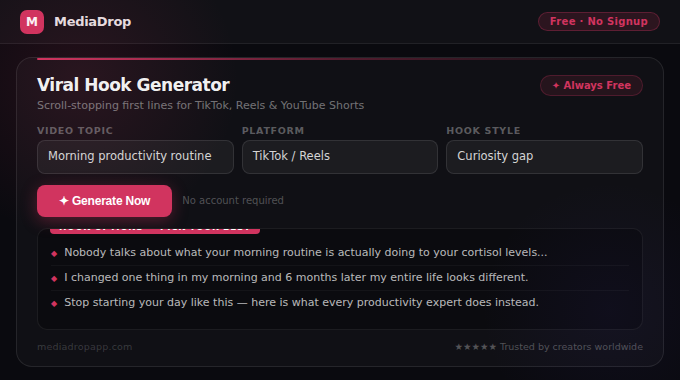
Use Viral Hook Generator to generate 10 hook variations for any video topic using proven formulas. Generate multiple options, identify the strongest 2–3, and test them.
Conclusion
The hook is the highest-leverage element of any short video. A 30-second investment in writing and testing better hooks delivers more growth impact than almost any other time investment in content creation. The formulas in this guide cover the main psychological triggers that stop scrolling: curiosity gaps, bold claims, story openers, problem recognition, specific numbers, identity targeting, reveal teases, and relatable observations.
Start by picking 2–3 formulas that feel most natural for your content and niche, write 3–5 versions of each, and test them in your next 10 videos. The data from those tests will tell you exactly which approach your specific audience responds to — and that knowledge compounds into faster growth with every video you make.