What YouTube Actually Rewards (The Growth Model)
YouTube's algorithm distributes content based on one core objective: maximising viewer satisfaction on the platform. Every metric YouTube tracks — click-through rate, watch time, audience retention, likes, comments, shares — exists as a proxy for that single goal. Understanding this changes how you approach growth.
The growth model works in three stages:
Stage 1: The thumbnail and title earn the click. YouTube tests your video against its current subscribers and users who watch similar content. The thumbnail and title determine click-through rate (CTR). Industry benchmarks: 2–5% CTR is average; 6–10% is strong; 10%+ is exceptional. YouTube shows higher-CTR videos to more people.
Stage 2: The video earns the watch time. Once someone clicks, the video must deliver on the promise of the thumbnail and title. Average Percentage Viewed (APV) tells YouTube how much of your video people watch. Higher APV signals that viewers found what they expected — and YouTube rewards that with wider distribution through search and suggested videos.
Stage 3: Consistent performance builds channel authority. When a channel consistently produces videos that earn high CTR and high watch time, YouTube builds a model of the channel's audience and proactively distributes new videos to that audience. This is the point at which growth accelerates — when YouTube itself becomes an active growth mechanism rather than something you fight against.
Every tactical recommendation in this guide serves these three stages. Skip any of them and you are building on an incomplete foundation.
Titles: The Most Underestimated Growth Variable
Your video title does three things simultaneously: tells YouTube what your video is about (SEO), communicates to potential viewers why this specific video is worth their time (CTR), and sets expectations that the video must then fulfil (retention). Most creators optimise for one of these but neglect the others.
SEO and keyword placement
YouTube is the world's second-largest search engine. Including the exact phrase your target viewer would search in your title — ideally in the first 5–7 words — is the foundation of YouTube search visibility. Use YouTube's autocomplete (type your topic and see what YouTube suggests) to identify real search queries. These suggestions are ranked by actual search volume.
CTR formulas that work
Beyond keywords, titles that drive high CTR in 2026 share common structural patterns:
- Numbers + specificity: '7 Ways to...' or 'I tried X for 30 Days' — specific numbers create credibility and promise a defined scope
- The challenge or transformation: 'How I [specific result] in [timeframe]' — personal transformation stories outperform generic how-to titles
- The mistake angle: 'Why [common practice] is Killing Your [outcome]' — audience-relevant pain points drive clicks
- The counterintuitive claim: 'Stop Doing [thing everyone does]' — challenges assumed knowledge
- The specific audience address: 'For Beginners Who [specific situation]' — directness converts viewers who recognise themselves
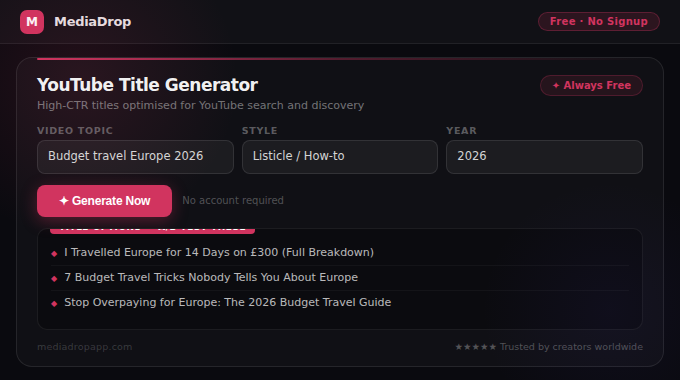
Use YouTube Title Generator to create 5 title options for any video topic using proven CTR formulas, each with keyword placement optimised for YouTube search.
Thumbnails: Your Single Highest-ROI Investment
YouTube's data consistently shows that thumbnails have more impact on click-through rate than titles for most videos. On mobile (where over 70% of YouTube viewing happens), thumbnails display larger relative to titles — making them the first thing a potential viewer processes.
What makes thumbnails actually work
High contrast: Your thumbnail must stand out in a feed of competing thumbnails. Use bright, contrasting colors that differ from the typical color palette of other videos in your niche. If most thumbnails in your niche use blue backgrounds, use orange or red.
One clear focal point: Thumbnails that try to communicate too much communicate nothing. One face, one reaction, one object, or one short text phrase. The viewer must be able to understand the thumbnail's message in under one second while scrolling.
Legible text (if used): If you add text to your thumbnail, use maximum 4 words in a large, high-contrast font. The text should add information the title does not already convey — not repeat the title.
Human faces with genuine expression: This is backed by extensive A/B testing data across channels of all sizes. Thumbnails with a human face expressing curiosity, surprise, excitement, or concentration consistently outperform thumbnails without faces. The expression should match the emotional tone of the video's content.
Brand consistency: Channels that use a consistent thumbnail style — same color scheme, same font, same general layout — build recognisability. When a viewer who has watched your videos before sees your thumbnail in their feed, they recognise it as your content before reading the title. This dramatically improves CTR from returning viewers.
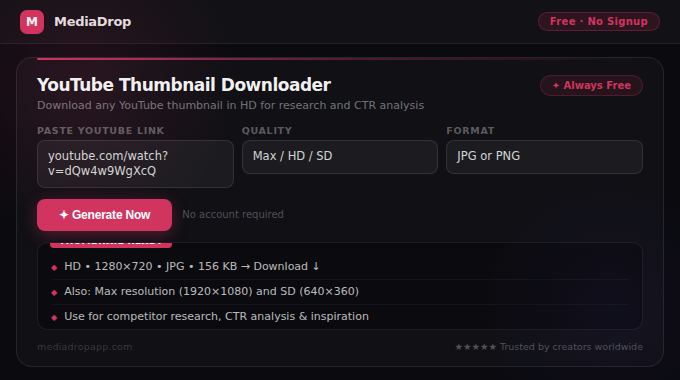
Download and study your top competitors' thumbnails using YouTube Thumbnail Downloader. Identify the patterns that their highest-performing thumbnails share, then apply those patterns to your own style. Resize your thumbnails to the correct 1280x720px YouTube specification with YouTube Thumbnail Resizer.
The First 30 Seconds: Where Channels Are Won or Lost
YouTube measures 30-second viewer retention as one of its earliest distribution signals. Videos that retain 70%+ of viewers through the first 30 seconds receive significantly broader initial testing. Videos that lose 40%+ of viewers in the first 30 seconds receive minimal further distribution regardless of later performance.
The most damaging intro patterns on YouTube in 2026:
- The credential intro: 'Hi, I am [name] and today I am going to show you...' — this tells the viewer nothing about the video's value and wastes the opening seconds
- The slow setup: Spending 2–3 minutes explaining context before delivering any value — many viewers have already left
- The like/subscribe ask: Asking for likes and subscriptions before delivering any value is a negative signal — it tells the viewer the creator needs something before they have given anything
- The long intro animation: 5-second logo animations might feel professional but they cost viewer retention
The intros that retain viewers:
- Start with the most compelling moment, claim, or question from the video's content
- Deliver one concrete value or insight in the first 30 seconds
- Create an open loop — tease something that requires watching the full video to resolve
- Address the viewer's main reason for clicking directly and immediately
Use YouTube Script Generator to create complete video scripts with intro hooks designed to maximise the critical 30-second retention window.
Posting Consistency: The Non-Negotiable Growth Driver
Consistency is not just a motivational talking point — it has specific algorithmic effects on YouTube. When you post consistently, YouTube builds a reliable model of your audience and begins proactively distributing your content before you have proven its quality. When you post inconsistently, YouTube treats each video as an unknown quantity and distributes it conservatively.
How often to post
The right posting frequency balances audience expectation, algorithmic momentum, and sustainable content quality. For most solo creators:
- Once per week: The standard that works for most YouTubers. Sustainable long-term without sacrificing quality. Creates a clear viewer expectation.
- Twice per week: Accelerates growth but significantly increases production load. Only sustainable if your video format is efficient to produce.
- Once every two weeks: Acceptable for highly produced long-form content (documentaries, deep dives) where quality justifies the slower cadence.
- Monthly or less: Too infrequent for the algorithm to build reliable distribution momentum. Growth stalls even with high individual video quality.
The worst pattern: posting 10 videos in three weeks then disappearing for two months. The algorithm's response to this is to effectively reset your channel's distribution status — each video gets treated as coming from an inactive channel.
Use Content Calendar Generator to plan a full month of YouTube topics in advance. A filled calendar eliminates the decision fatigue that causes consistency breaks.
SEO: Getting Your Videos Found Through Search
YouTube search drives consistently higher lifetime views than suggested/browse traffic because search viewers are actively looking for content on your topic — they are high-intent viewers who are more likely to watch your video fully and subscribe. A well-optimised video can rank in YouTube search for months or years after posting.
The three-part SEO approach
1. Keyword research: Use YouTube autocomplete for real search queries. Check the video count for your keyword (fewer competing videos = better chance of ranking). Target keywords where the existing top results are not from massive channels — you can rank against similar-sized channels, not against MrBeast.
2. On-page optimisation: Include your primary keyword in the title (first 5–7 words), the first 2–3 lines of the video description, and your tags. Use YouTube Description Generator to write full SEO-optimised descriptions with the correct keyword density and structure. Use YouTube Tags Extractor to generate 20 relevant tags for any video topic.
3. Engagement signals: YouTube ranks higher the videos that keep viewers watching after clicking from search. High average view duration is the most powerful ranking signal for search results. A video that ranks on page 2 with great retention will climb to page 1 over time; a video on page 1 with poor retention will fall.
Conclusion
YouTube growth comes from understanding and consistently executing the things the algorithm rewards: thumbnails that earn clicks, titles that convert search intent into views, intros that retain viewers through the first 30 seconds, and consistent posting that builds channel authority over time. Each element feeds the next — no single element makes or breaks a channel, but neglecting any one of them creates a ceiling on growth.
The creators who grow fastest on YouTube in 2026 are not the ones who chase trends or post the most — they are the ones who deeply understand their niche audience, consistently deliver on their thumbnail and title promises, and use every available tool to produce quality content more efficiently.