Why Instagram Captions Are More Important Than Most Creators Realise
Instagram's algorithm uses multiple engagement signals to decide which posts to show more widely. The signals it values most — saves and shares — are both heavily influenced by caption quality. A post that someone saves because the caption contains genuinely useful information, or shares because the caption perfectly captured something they relate to, sends a far stronger algorithmic signal than a simple like.
Captions also directly drive comments — and comment threads signal active community engagement, one of the strongest metrics Instagram uses to determine whether to push content to Explore and new audiences. A caption with a genuine, specific question that followers want to answer generates comment activity that a caption without one simply cannot.
Finally, captions provide context and voice. A photo of a meal is just a photo — a caption about the specific story behind making it, the mistake that led to a happy accident, or the three things the creator learned from cooking it three times before getting it right is what makes someone follow rather than just like and move on.
The Three-Part Caption Structure That Consistently Performs
The most reliably high-performing Instagram captions follow a three-part structure, regardless of length or niche:
Part 1: The Hook (first 1–2 lines)
Instagram shows only the first 125 characters before the 'more' button. This opening is your only chance to earn the reader's decision to expand the caption. It must be compelling enough on its own to stop someone mid-scroll and make them want to read more.
Hook formulas that consistently work:
- The curiosity gap: 'This one ingredient changed every salad I make. Here is what it is.'
- The bold claim: 'Most people do this wrong when they start working out.'
- The relatable moment: 'That specific panic when you check your bank account after a long weekend.'
- The counterintuitive statement: 'Posting less grew my account faster.'
- The direct question: 'What did nobody tell you when you started your career?'
The worst hook is describing exactly what is shown in the photo with no additional angle or hook. 'A beautiful Sunday morning breakfast' gives someone no reason to tap 'more'.
Part 2: The Body (the substance)
After the hook earns the reader's attention, the body delivers the value that justifies it. Depending on your content type and niche, this might be: a story, a list of tips, an explanation, a personal reflection, or educational content. The body is where you give the reader something genuinely useful, interesting, or emotionally resonant.
Specific details outperform generic observations in every niche. 'I felt better after changing my routine' is forgettable. 'After 90 days of sleeping before midnight and cutting my phone use by 40 minutes before bed, my morning anxiety dropped significantly' is specific enough to be memorable and shareable.
Part 3: The Call-to-Action (what to do next)
Every caption should tell readers what to do with the information or emotion you just gave them. The CTA can be an engagement prompt (question, challenge, request to tag someone), a save prompt ('save this for when you need it'), or a link prompt ('full guide in bio'). Without a CTA, many readers will feel the natural satisfaction of having consumed the content and move on — engagement is lost.
High-performing CTAs:
- 'Save this post — you will want it later.'
- 'What would you add? Drop it in the comments.'
- 'Tag a friend who needs to see this.'
- 'Agree or disagree? Tell me below.'
- 'Follow for more on [specific topic].'
Caption Length: When to Go Short vs Long
The right caption length depends on your content type, not on arbitrary best practices. Both short and long captions can perform exceptionally well — the question is which serves your specific post's purpose.
When short captions (under 50 words) work best
Short captions work when the visual content is so strong that it does not need explanation, when the caption serves as a caption (describes the moment), or when brevity is itself the statement. Fashion posts, aesthetic lifestyle photos, motivational quotes over strong images, and humour posts often perform best with minimal caption text because additional words would dilute the impact of the visual.
Example of a short caption that works: 'Three years of work. Worth every second.' (Under a photo of a finished project) — the brevity makes the emotional weight of the caption land harder.
When long captions (150+ words) work best
Long captions outperform short ones for educational content, personal stories, controversial opinions, tutorials, and any post where you are asking the audience to change their thinking or behaviour. Long captions signal investment — they tell the reader that you took time to write this, which increases perceived value.
The best long captions read like micro-essays: a compelling opening, a main point supported by specific details or a story, a secondary insight that reinforces the main point, and a conclusion that crystallises the takeaway or poses a question.
The sweet spot for most posts
For most feed posts, 100–200 words hits the right balance — enough to deliver substance and drive engagement, short enough to be read by someone quickly scrolling. Reels and Stories typically perform better with shorter captions since the video itself is the primary content.
Real Caption Examples by Post Type
These examples illustrate the three-part structure applied to different content types and niches:
Food / Recipe post:
'I ruined this dish four times before getting it right. ↓ [hook]
The problem was always the same: too much heat, not enough patience. Caramelised onions take 35–40 minutes on medium-low heat. Not 15 minutes with the heat turned up. Every shortcut I tried made them bitter and caught on the pan.
Week four, I finally let them go the full 40 minutes without touching them, and they came out perfect — sweet, deep brown, almost jammy. I made them the star of a grilled cheese with Gruyère and Dijon, and it is now the most requested thing I make.
The lesson for me was that good cooking and good business have the same core truth: the things worth having do not respond well to rushing. [body]
What is one thing in your kitchen you have been rushing that might need more time? [CTA]'
Fitness post:
'Nobody told me the hardest part of getting fit was not the workouts. [hook]
It was showing up on the days when nothing felt like it was working. The days where the scale did not move and the weights felt heavier than last week and my energy was at zero.
In two years of consistent training, I had maybe 40 days that felt genuinely great. The other 690 were just showing up anyway. And that is actually the whole thing.
Motivation is for starting. Discipline is for continuing. [body]
What keeps you showing up when you do not feel like it? [CTA]'
Notice: both captions use specific details (35–40 minutes, not 'a long time'; 690 days, not 'most days'), tell a real story rather than dispensing generic advice, and end with a genuine question rather than a generic 'comment below'.
Hashtags in Instagram Captions: What Actually Works in 2026
The optimal Instagram hashtag strategy has shifted significantly in recent years. Instagram itself has recommended using 3–5 highly relevant hashtags rather than the 20–30 generic tags that used to be standard practice.
Current best practices
- 3–8 targeted hashtags outperform 20–30 generic ones in reach for most accounts
- Mix three hashtag sizes: one or two broad niche tags (500K–2M posts), two or three mid-size niche tags (50K–500K posts), and one or two very specific tags (under 50K posts) where you have a realistic chance of ranking
- Hashtags in the caption or first comment — both work; first comment keeps the caption cleaner
- Avoid banned hashtags — using a banned hashtag can suppress the entire post's reach
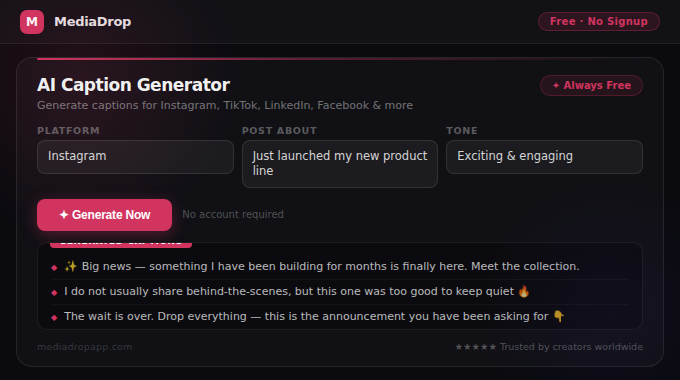
Use Instagram Hashtag Generator to find a strategic mix of hashtags for any post topic, sized correctly for your account and niche. Use AI Caption Generator to generate complete captions with integrated hashtag suggestions for any platform and content type.
Frequently Asked Questions About Instagram Captions
How many emojis should I use?
1–3 emojis used intentionally (to highlight a key word, break up text sections, or add personality) outperform zero emojis (makes captions feel flat) and 10+ emojis (looks unprofessional and distracts from the text). Use emojis where they add meaning, not just decoration.
Should I write captions in first or third person?
First person for personal content and storytelling. Third person is almost never appropriate for Instagram captions — it sounds robotic and creates distance between you and your audience.
How do I add line breaks to Instagram captions?
On mobile: press Return/Enter as normal. On desktop: Instagram sometimes removes line breaks — write your caption in Notes app first, then copy-paste. Use periods or emojis as the last character before a line break if Instagram collapses the spacing.
When is the best time to post for caption engagement?
Caption engagement is less time-sensitive than overall post performance. However, posts that receive high engagement in the first 30–60 minutes after posting get wider distribution. Check your Instagram Insights → Audience tab to see when your specific followers are most active.
Conclusion
Great Instagram captions are not about length or hashtag counts — they are about giving your audience a reason to stop, read, feel something, and act. The hook earns attention; the body delivers value; the CTA converts that value into engagement signals that tell the algorithm to show your content to more people.
Treat every caption as a small piece of writing that could stand alone — even without the image. When the caption itself is worth reading, the combination of strong visual and strong caption creates a post that spreads. Use Instagram Caption Generator to generate 5 caption options for any post in seconds, then personalise the best one with your specific details and voice before posting.