How Instagram Hashtags Actually Work in 2026
Instagram uses hashtags for two purposes: categorisation (telling Instagram what your content is about, so it can show it to interested users) and direct discovery (allowing users who browse or search specific hashtags to find your content).
The platform's official guidance has shifted significantly in recent years. Instagram's own Head of Instagram, Adam Mosseri, stated that hashtags have a relatively minor direct impact on reach compared to factors like how quickly content generates engagement after posting. This does not mean hashtags are useless — it means they work differently than the old 'use 30 hashtags for maximum reach' advice suggested.
The three hashtag size tiers and how to use them
Every effective Instagram hashtag strategy mixes three tiers of hashtags based on post volume:
Tier 1 — Niche-specific small hashtags (under 500K posts): These are where smaller accounts have the best chance of appearing in the Top Posts section. A food blogger with 5,000 followers has virtually zero chance of ranking in #food (500M+ posts) but a reasonable chance of ranking in #mealprephacks (200K posts) or a specific cuisine hashtag. Niche hashtags reach a smaller but more targeted audience — people actively browsing that specific tag are more likely to engage.
Tier 2 — Mid-size niche hashtags (500K–5M posts): These provide a balance of reach and ranking potential. You are unlikely to rank in the top posts section unless your content performs exceptionally well, but your post will appear in the Recent feed and may be surfaced to engaged users in that niche. These are your core hashtags.
Tier 3 — Broad category hashtags (5M+ posts): These have enormous audiences but virtually no ranking potential for most accounts. They serve as categorisation signals for Instagram's algorithm more than direct discovery channels. Use 1–2 maximum, not the majority of your hashtag set.
How many hashtags to use
Instagram's own recommendation (2023 and updated 2024) is 3–5 highly relevant hashtags. Testing across accounts of different sizes consistently shows that 5–10 targeted hashtags outperform both 1–2 hashtags (too few to capture varied search) and 20–30 hashtags (dilutes relevance signals). For most accounts, 6–8 well-chosen hashtags is the practical optimal range.
TikTok Hashtag Strategy: Different Rules, Different Approach
TikTok hashtag strategy differs from Instagram in important ways because TikTok's discovery system works differently. TikTok distributes content primarily based on content signals (what you post, who engages with it) rather than social graph (who follows you) — hashtags are one of those content signals.
The #fyp myth
TikTok has explicitly and repeatedly confirmed that #fyp, #foryou, #foryoupage, and similar generic 'get on For You Page' hashtags have no special algorithmic function. They are among the most crowded hashtags on the platform and their use provides no advantage. Despite this, millions of videos still include them — which means not using them gives you no disadvantage while using them wastes a hashtag slot.
How TikTok hashtags work
TikTok hashtags primarily serve two functions: they tell TikTok's algorithm what category your content belongs to, which influences the initial test audience selection; and they make your content discoverable through TikTok Search, which has grown significantly as a content discovery channel — particularly among younger audiences who use TikTok search the way other generations use Google.
TikTok hashtag quantity and selection
3–5 targeted hashtags is the consistent recommendation from TikTok and supported by creator testing. The optimal mix: one broad category hashtag (#fitness, #cooking, #finance), two to three specific niche hashtags (#kettlebellworkout, #highproteinmeal, #sidehustleideas), and optionally one trending hashtag that is relevant to your content. Trending hashtags on TikTok have a short window of relevance — 24–72 hours typically — so they need to be used immediately when they are rising.
For TikTok specifically, placing hashtags at the end of your caption naturally (not in a separate group below the text) integrates them more smoothly with the content signal they are meant to provide.
How to Research Hashtags for Your Specific Niche
The best hashtag research combines platform tools, competitor analysis, and AI-assisted generation:
Method 1: Platform search autocomplete
Search your niche keyword in Instagram or TikTok's search bar and note all the autocomplete suggestions. These suggestions are ranked by actual search and browse volume on the platform. They show you exactly what users are searching for in your topic area — which is exactly the audience you want to reach. Note the post counts next to each suggestion to identify which tier they fall in.
Method 2: Competitor hashtag analysis
Look at the posts from accounts in your niche that are slightly larger than yours (not the mega-accounts — their hashtag strategy may not be what got them there, and they rank through authority, not hashtag optimisation). Note which hashtags appear consistently across their best-performing posts. These are likely the hashtags that are actively working in your niche.
Method 3: AI-assisted research
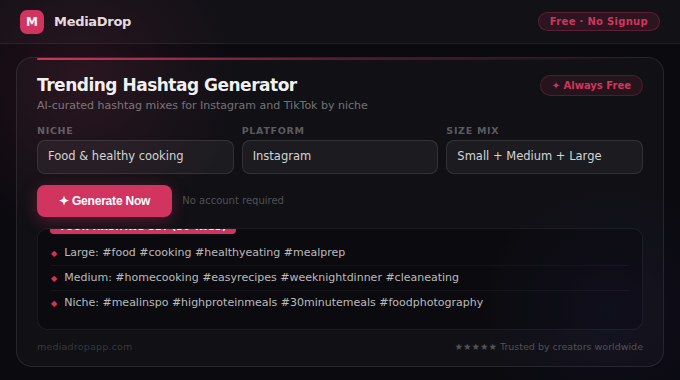
Use Trending Hashtag Generator to get an AI-curated set of hashtags for any niche and platform, including a strategic mix across tiers. Use Instagram Hashtag Generator for Instagram-specific hashtag sets or TikTok Hashtag Generator for TikTok. These tools generate hashtag sets informed by current platform trends and niche-specific performance data.
Hashtag Mistakes That Kill Reach
These are the most common hashtag mistakes and why they damage your reach:
Using banned hashtags: Instagram maintains a list of banned or restricted hashtags — tags associated with spam, misinformation, or policy violations. Using a banned hashtag in your post can suppress the entire post's reach, not just the reach from that specific hashtag. Banned hashtags are not always obvious (some seemingly innocent tags have been banned due to spam abuse). If you notice a particular hashtag shows no 'Recent' posts when you search it, it is likely restricted. Avoid it entirely.
Using the same hashtag set for every post: Using identical hashtags on every post is a pattern associated with spam accounts. Instagram's algorithm identifies and de-prioritises repetitive hashtag patterns. Rotate your hashtag sets — keep 3–4 core hashtags consistent and change the rest based on the specific content of each post.
Using irrelevant hashtags because they have large audiences: Using #travel on a fitness post because travel hashtags have large audiences is a misunderstanding of how hashtags work. The travel audience is not interested in fitness content — they are not going to engage. Low engagement on a high-volume hashtag sends a negative signal. Only use hashtags that accurately describe your content.
Using only huge hashtags: A follower count of 2,000 using only hashtags with 50M+ posts will never appear in those feeds. The competition is simply too high. Smaller, niche hashtags give realistic ranking opportunities.
Measuring Whether Your Hashtags Are Working
Instagram Insights (available for Business and Creator accounts) shows hashtag reach — the number of accounts that found your post through hashtags — as a separate figure from your follower reach. Check this for each post to understand which hashtag sets are driving discovery.
A hashtag set is working when hashtag impressions represent a meaningful percentage of total impressions (10–30% is a healthy range for growing accounts). If hashtag impressions are consistently 1–3% of total impressions, your hashtag set is not driving meaningful discovery — it is time to research and test new tags.
On TikTok, the analytics breakdown shows Views from For You (algorithm-driven), Views from Following (follower feed), and Views from Search (search-driven). If you are optimising hashtags for TikTok search discovery, watch the 'Views from Search' figure trend over time as you improve your hashtag and caption keyword strategy.
Conclusion
Effective hashtag strategy in 2026 is about relevance and targeting, not volume. On Instagram: use 6–8 targeted hashtags mixing all three size tiers, rotate your sets, and check your hashtag reach metrics to see what is working. On TikTok: use 3–5 targeted hashtags, skip the generic #fyp tags, and focus on niche-specific terms that connect your content to the right audience.
The biggest improvement most accounts can make is replacing large generic hashtags with smaller, more specific ones relevant to their exact content and niche. This single change shifts your discoverability from theoretically competing with millions of posts to practically reaching an audience genuinely interested in your specific content.