Why Content Calendars Drive Social Media Growth
Creators who plan content in advance consistently outperform those who post reactively. The reasons are straightforward: planned content is higher quality because it was not rushed. Planned creators post more consistently because they always know what comes next. Planned content maintains a strategic mix of educational, entertaining, and promotional material rather than defaulting to whatever is easiest to produce on any given day.
Research across Instagram, TikTok, and YouTube consistently shows that posting consistency is a stronger predictor of follower growth than posting quality alone. An account that posts three times per week, every week, with good (not exceptional) content grows faster than an account that posts ten times one week, once the next, and nothing the week after — even if the sporadic account's content is objectively better. Algorithms reward consistency because it keeps audiences engaged and returning regularly.
A content calendar solves the three most common consistency killers: decision fatigue (not knowing what to post), time constraints (not having time to create when it's time to post), and motivation dips (not feeling inspired on a given day). When the plan is already made, you show up to execute rather than also having to create from scratch.
The 5-Column Content Calendar Structure
The most functional content calendar structure for social media creators uses five columns. You can build this in Google Sheets, Notion, Airtable, or any spreadsheet tool.
Column 1 — Date: The specific date you plan to post. Include the day of the week for quick reference (Mon 3 June, Tue 4 June, etc.).
Column 2 — Platform: Which platform this post is for. If you are posting the same content to multiple platforms, create a separate row for each adaptation — platform-specific optimisation matters.
Column 3 — Format: The content format. Options include: Reel/Short video, Carousel/Slideshow, Static image post, Story, YouTube video, Blog post, Newsletter. Different formats require different creation resources and production timelines.
Column 4 — Topic: The specific content idea. Be specific enough that you know exactly what to create when you open this row. 'Fitness post' is too vague. '3 mistakes beginners make with squats (form check Reel)' gives you everything you need to create the content.
Column 5 — Status: Track each post through your production workflow. Common statuses: Idea → Scripted → Filmed/Designed → Edited → Captioned → Scheduled → Published. Seeing all your content across the pipeline helps you manage production time and ensures nothing falls through.
The Right Content Mix for Sustained Growth
A balanced content calendar prevents the two most common content strategy mistakes: posting too much promotional content (which trains followers to ignore your posts) and posting exclusively entertaining content that never connects to your business goals.
The content mix that consistently performs across platforms in 2026: 40% Educational — how-to content, tips, tutorials, explanations, frameworks. This establishes authority and gives followers a reason to save and share your posts. 30% Entertaining — behind-the-scenes content, relatable moments, humor, personal stories, day-in-my-life content. This builds personal connection and makes your account enjoyable to follow. 20% Engaging — questions, polls, 'this or that' choices, fill-in-the-blank prompts, challenge participation. This drives comments and conversation which boosts algorithmic distribution. 10% Promotional — product mentions, service CTAs, affiliate links, launches. This serves your business goals without overwhelming your audience.
This 40/30/20/10 ratio is a starting point, not a rule. Adjust based on your specific niche and audience feedback. Monitor which content types generate the most saves, shares, and comments — those are the types your specific audience values most.
Platform-Specific Posting Frequencies
The right posting frequency varies significantly by platform. Posting too infrequently loses algorithmic momentum. Posting too frequently exhausts your production capacity and reduces average content quality.
Instagram: 4–5 times per week is the current sweet spot for most growth-focused accounts. Include a mix of Reels (highest reach potential), carousels (highest save rates), and occasional static posts. Stories should be posted more frequently — 5–10 per week — as they function differently to feed content.
TikTok: 5–7 videos per week for accounts actively trying to grow. TikTok rewards higher posting frequency more than other platforms because each video is tested independently and even a small account's video can go viral. Do not sacrifice quality for volume — 4 good videos outperform 7 mediocre ones.
YouTube: 1–2 videos per week is achievable for most solo creators and provides enough content for the algorithm to recommend consistently. Quality matters more on YouTube than any other platform — one exceptional 10-minute video per week outperforms four rushed 5-minute videos.
LinkedIn: 3–4 posts per week for professional creators. LinkedIn rewards consistency and thoughtful content over volume. Long-form posts (500–1,500 words) consistently outperform short updates.
Generate Your Content Calendar with AI in Minutes
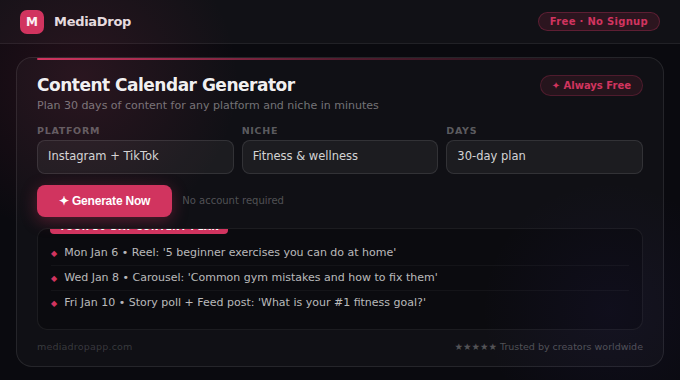
Instead of building your content calendar from scratch each month, use the AI Content Calendar Generator to create a complete 30-day posting plan for your niche and platform in seconds. Enter your topic, select your platform, choose your posting frequency, and receive a structured calendar with specific content ideas, formats, and posting types for every planned posting day.
The AI generator creates a calendar that automatically includes the right content mix — educational, entertaining, engaging, and promotional content distributed across the month. It adapts the content ideas to your specific niche, so a fitness account and a finance account get completely different calendars despite using the same tool.
Use the generated calendar as your starting point. Review each content idea and add your personal angle, specific examples from your experience, or timely references to current events in your niche. The AI gives you the structure and direction — your knowledge and personality make the content worth following.
For additional content ideas beyond the calendar, use the Niche Content Ideas Generator to get 20–30 more specific post concepts for your niche. Keep a running ideas document and add to it whenever inspiration strikes — a filled idea bank makes every planning session faster and easier.